
Armor in Minecraft: a guide
Leather to netherite
4 (helmet, chestplate, leggings, boots)
20 points (netherite)
12 (netherite)
40% (netherite only)
Table of contents
What armor is in Minecraft
Armor is a category of items you wear in dedicated inventory slots to take less damage. Every set has four pieces: a helmet, a chestplate, leggings and boots. Each piece goes in its own slot, so you can't wear two helmets at once.
The armor system rests on three stats. The first is Armor Points, shown above the health bar as armor icons. You can have 20 points at most, which fills 10 full icons. The second is Armor Toughness, a hidden attribute that only shows up on diamond and netherite armor. The third is Knockback Resistance, which only netherite armor has and which shortens how far a hit knocks you back.
To put armor on, open your inventory (the E key by default) and drag the pieces into the slots to the left of your character. The faster way is to right-click while holding a piece, and the game puts it in the right slot automatically. A chestplate and an elytra share the same slot, so you wear one or the other and can swap between them quickly.
Armor wears down with every hit you take. When its durability reaches zero, the piece breaks and disappears from your inventory. You restore durability at an anvil (by combining two identical pieces or by using the right material) or with the Mending enchantment, which spends the XP you collect to repair durability.
Armor types and materials
Minecraft has several armor materials. Each one differs in protection, durability, availability and special traits. Here is an overview from weakest to best:
Leather armor
The weakest set, but the only one you can dye any color with dyes. You get leather by killing cows, horses, llamas, donkeys and mules, or by crafting it from 4 rabbit hides. A full leather set gives just 7 armor points and has low durability, but it still beats nothing on your first night in Survival. Leather armor also protects you from freezing in powder snow.
Gold armor
Gold protects better than leather (11 points), but it wears out fast: the chestplate has only 112 durability (iron has 240). Gold does have one very important perk, though: piglins in the Nether don't attack a player who wears at least one piece of gold armor. A gold helmet or a pair of gold boots is enough to keep them calm while you trade with them through bartering. Gold armor also takes higher-level enchantments at the enchanting table because of its higher enchantability (25 vs. 9 for iron).
Chainmail armor
Chainmail is the only armor you can't craft. You can only get it by trading with an Armorer at Apprentice and Journeyman levels, from mobs wearing chainmail (zombies and skeletons, for example) or from chests in generated structures. A full set gives 12 armor points, which puts it between gold and iron. Its durability is the same as iron's (240 for the chestplate). In practice chainmail is a collector's curiosity, since iron is easier to get and better.
Iron armor
The workhorse of the mid-game. Iron is common, easy to mine and gives a solid 15 armor points for a full set. The chestplate has 240 durability. Most players jump from leather straight to iron and skip gold and chainmail. You find iron ore from Y -64 to 72 (best around Y 15-16), or you can skip the digging with an iron golem farm, which gives you an unlimited supply.
Diamond armor
The best armor you can craft directly. A full set gives 20 armor points (the maximum the bar shows) and, importantly, has Armor Toughness (8 for a full set), which blunts strong attacks even more. The chestplate has 528 durability. A full set takes 24 diamonds. You mine diamonds from Y -64 to 16, with the best generation at Y -59.
Netherite armor
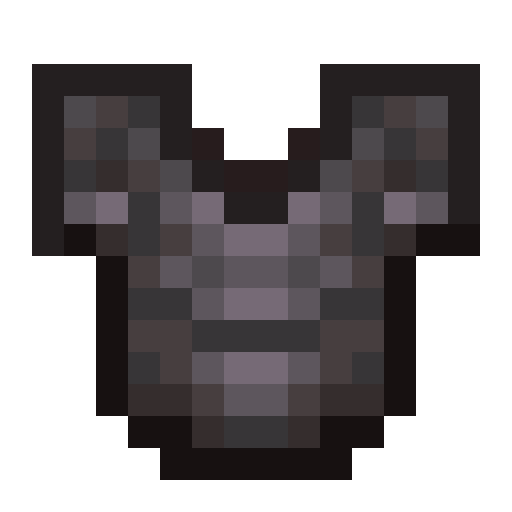
The absolute top. You don't craft netherite armor from scratch. You upgrade diamond armor at a smithing table with a netherite ingot and a Netherite Upgrade smithing template. A full set gives the same 20 armor points as diamond, but with higher Armor Toughness (12 instead of 8) and a unique Knockback Resistance +10% on every piece (40% in total). Netherite items don't burn up in lava or fire and float on the surface. The chestplate has 592 durability.
Armor points table
The table below shows how many armor points each piece gives, by material:
Diamond and netherite give the same 20 armor points. The difference comes from Armor Toughness and Knockback Resistance, covered below.
Armor durability
Every hit takes durability from your armor. When a piece's durability drops to 0, it breaks. Here is the full durability table:
The Unbreaking enchantment effectively extends durability. Combined with Mending, armor becomes practically permanent.
How to craft armor
Crafting armor takes a crafting table and the right material. The pattern is the same for every material, and only the ingredients change. Here is how much you need for each piece:
A full set takes 24 units of material (5 + 8 + 7 + 4). In raw resources that is, for example, 24 iron ingots, 24 diamonds or 24 gold ingots. For leather you need 24 leather (from cows) or 96 rabbit hides (4 per leather).
Damage reduction formula
Minecraft's protection system isn't linear. The game works out the final damage from your Armor and Armor Toughness values using this formula:
// Step 1: calculate the effective defense points
defensePoints = max(Armor / 5, Armor - damage / (2 + Toughness / 4))
// Step 2: limit it to 0-20
defensePoints = clamp(defensePoints, 0, 20)
// Step 3: calculate the final damage
finalDamage = damage * (1 - defensePoints / 25)
In practice, weak hits (a zombie hit of 3 HP, say) are cut by about 77% by a full diamond set (20 Armor, 8 Toughness), so you take only about 0.7 HP. Against a huge blow (a charged creeper blast of 64 HP, say) the reduction drops to 16%, because the formula penalizes armor against strong hits. This is where Armor Toughness comes in: netherite, with its higher Toughness (12), handles strong attacks better than diamond.
Protective enchantments (Protection, Fire Protection, Blast Protection, Projectile Protection) stack on top of this base reduction and can increase it. Together they can cut at most 80% of the damage that gets through. A full netherite set with Protection IV on every piece turns a 10 HP hit into about 1 HP.
Armor Toughness
Armor Toughness is a stat that only diamond and netherite armor has. Its job is to protect against strong attacks piercing your armor. Without Toughness, a heavy hit (say, 30 HP from the Warden) ignores a good chunk of your protection. With high Toughness, your armor stays effective even against brutal blows.
A gap of 4 Toughness points between diamond and netherite looks small, but it matters in fights with the Warden, the Wither and other bosses. Against a 30 HP hit, full diamond armor cuts the damage by 50% and full netherite by 56%. That difference can decide whether you survive.
Armor enchantments
Enchantments boost the effectiveness of armor dramatically. Here are the most important protective enchantments for each piece:
Enchantments for any armor piece
- Protection I-IV - reduces all types of damage. Universal and the most popular pick.
- Fire Protection I-IV - reduces fire and lava damage. Doesn't combine with Protection.
- Blast Protection I-IV - reduces explosion damage (creepers, TNT). Doesn't combine with Protection.
- Projectile Protection I-IV - reduces damage from arrows, tridents and fireballs. Doesn't combine with Protection.
- Unbreaking I-III - a chance to take no durability damage when you are hit.
- Mending - repairs durability with the XP you collect.
- Thorns I-III - damages whoever attacks you. Wears the armor out faster.
Piece-specific enchantments
- Helmet: Respiration I-III - longer breath underwater. Aqua Affinity - normal mining speed underwater.
- Chestplate: No unique enchantments (or an elytra in this slot).
- Leggings: Swift Sneak I-III - faster movement while sneaking.
- Boots: Feather Falling I-IV - less fall damage. Depth Strider I-III - faster movement in water. Frost Walker I-II - freezes the water under your feet. Soul Speed I-III - speed on soul sand and soul soil.
Armor trims
Since version 1.20 (Trails & Tales) you can decorate armor with patterns using smithing templates and trim materials. Trims are purely cosmetic, so they don't change protection or durability, but they let you make unique sets that stand out on multiplayer servers.
The system works at a smithing table: you put in a piece of armor, a smithing template with a pattern and a trim material (for example diamond, gold, lapis lazuli or amethyst). Each material gives a different color. You find the templates in specific structures around the map, and the details are on the Armor trims page.
Every pattern can be combined with every trim material, which gives well over a hundred different combinations for a single piece of armor. You can duplicate templates at a crafting table with 7 diamonds and the matching base block.
Special protective items
Besides classic armor, Minecraft has a few extra protective items:
Shield
A shield blocks damage from the front while you hold the right mouse button. It blocks 100% of the damage from melee attacks, arrows and explosions that hit you from the front. Crafting: 1 iron ingot + 6 planks. Durability: 336. You can decorate it with a banner. A hit from an axe disables a shield for 5 seconds.
Elytra
The elytra are glider wings found in End ships. They take up the chestplate slot, so you have to choose between chestplate protection and the ability to fly. Durability: 432. With firework rockets, the elytra lets you keep up powered flight for as long as your rockets last.
Wolf armor
Wolf armor is armor for a tamed wolf, added in version 1.20.5. Crafting takes armadillo scutes. Wolf armor gives the wolf 11 armor points, and you can dye it any color.
Horse armor
Horse armor comes in several versions, including leather, iron, golden and diamond. You can craft leather horse armor (7 leather). Iron, golden and diamond horse armor can only be found in chests in dungeons, desert temples, Nether fortresses and ancient cities. Horse armor doesn't wear out, because it has infinite durability.
Armor stand
An armor stand gives no protection by itself, but it is a handy decoration that lets you put armor on display in your base. Crafting: 6 sticks + 1 smooth stone slab. In Bedrock Edition, armor stands have extra poses that you can set without commands.
Tips and strategies
Piglins attack players who aren't wearing any gold armor. One piece is enough, so wear a gold helmet or boots and keep the rest of the set diamond or netherite. A gold helmet is the cheapest swap: it gives 2 armor points against 3 for a diamond helmet, so you lose just 1 point.
Mending repairs durability with the XP you collect. With a good XP farm (an enderman farm, say), your armor never wears out. Unbreaking extends the lifespan, but it doesn't repair anything, so the armor breaks in the end. Having both is ideal, but if you must choose, take Mending.
Protection IV on all 4 pieces gives the maximum reduction (16 EPF = 64% reduction from enchantments). Mixing Protection with Fire, Blast or Projectile Protection lowers your overall protection, because the specialized enchantments only work against their own damage type. The exception is a PvP server with a lot of archers, where Projectile Protection IV on the chestplate makes sense.
Thorns damages attackers, but it makes your armor wear out faster. On netherite with Unbreaking III and Mending that doesn't matter, but on iron armor without those enchantments Thorns will shorten its life dramatically. Skip it in the early game.
Instead of mining iron, build an iron golem farm. A simple farm with 3 villagers gives enough iron for a steady supply of armor and tools. A bigger farm (20+ villagers) gives you plenty of iron for a whole server.
An Armorer villager at Expert and Master level sells enchanted diamond armor for emeralds. On a server with well-developed villager trading you can get a full enchanted diamond set without mining a single diamond: emeralds from trading with a Farmer are enough.
Frequently asked questions (FAQ)
What is the best armor in Minecraft?
The best armor in Minecraft is netherite. A full set gives 20 armor points, 12 Armor Toughness and 40% knockback resistance. Netherite gear also doesn't burn up in lava or fire.
How many diamonds do you need for a full set of armor?
A full set of diamond armor takes 24 diamonds: 5 for the helmet, 8 for the chestplate, 7 for the leggings and 4 for the boots. To upgrade it to netherite you also need 4 netherite ingots and 4 Netherite Upgrade smithing templates.
How does armor protection work in Minecraft?
Every point of Armor reduces the damage you take. The formula is: damage taken = original damage × (1 - min(20, max(Armor/5, Armor - damage/(2 + Toughness/4))) / 25). With Protection IV on every piece, a full netherite set cuts a typical hit by roughly 90%.
Is gold armor better than leather?
Gold armor gives more protection than leather (11 vs. 7 points for a full set) and a bit more durability too, but it is still much weaker than iron. Gold also helps a lot in the Nether, because piglins don't attack a player wearing gold armor.
How do you get chainmail armor in Minecraft?
Chainmail armor can't be crafted. You can only get it by trading with an Armorer villager at Apprentice and Journeyman levels, from drops of mobs wearing armor, or from chests in generated structures.
What is Armor Toughness?
Armor Toughness is an attribute that doesn't show on the armor bar and appears only on diamond and netherite armor. It blunts strong attacks that would otherwise pierce armor. A full diamond set gives 8 Toughness and a full netherite set gives 12.
Related pages
- Armor trims - patterns, materials, template locations
- Netherite armor - how to upgrade diamond armor to netherite
- Wolf armor - armor for a tamed wolf
- Minecraft enchantments - the full enchantment database
- Villager professions - the Armorer and other jobs
- Anvil - repairs and combining enchantments
- Smithing template - the smithing table and templates
- Nether - exploring the Nether