
 5 min read
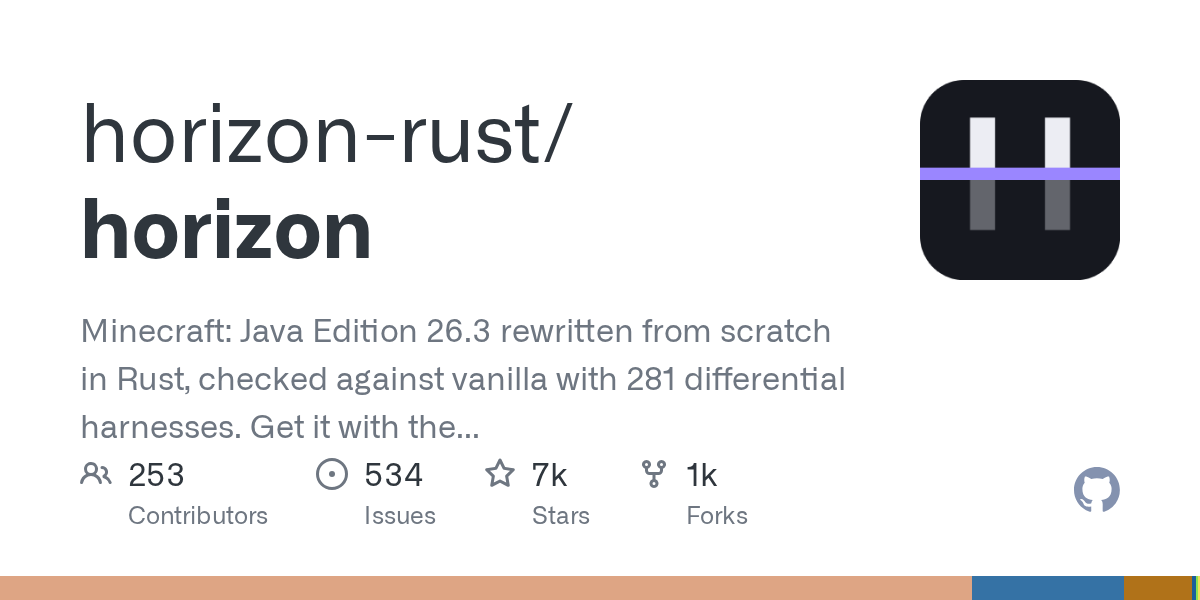
Horizon is an open source project that, in just a few weeks, rebuilt Minecraft: Java Edition 26.3 from the ground up in Rust, relying heavily on the work of Claude AI agents. The repository on GitHub has already racked up more than 6,500 commits, around 2,800 stars, and 200 forks, and its authors claim their implementation passes all 281 differential tests comparing its behavior to the original. On the same RTX 4080 graphics card, Horizon can render the world at significantly higher frame rates at shorter render distances and uses roughly half the RAM compared to the original Java Edition.
What Horizon actually is
Horizon is a new game engine, not a mod or a launcher with patches: it's an entire program written from scratch in Rust that aims for so-called "one-to-one vanilla parity" with Minecraft: Java Edition 26.3. It reads the same worlds, operates by the same rules, and generates terrain identical to the original, which the authors back up with tests comparing 2,352 complete chunks across 225 structure locations in all three dimensions. It's installed through its own launcher at playhorizon.dev, but it requires owning a legitimate copy of the game: you first have to launch the official Mojang launcher, play version 26.3 once, so Horizon can pull the files it needs from that installation.
The developers stress that the project "does not ship Minecraft code, assets, or data" and is not endorsed by Mojang or Microsoft. Anyone who wants to check out the original first can find every version of the game on the download Java Edition page. Single-player gameplay, local network play, servers, resource packs, and native Horizon mods already work today, although full compatibility with the whole mod ecosystem doesn't exist yet.
Performance results that caught the community's attention
At a render distance of 12 chunks, Horizon averages 2,993 FPS compared to 2,600 FPS in the original Java Edition on identical hardware. At a render distance of 32 chunks, the tables turn: Horizon drops to 672 FPS, while Java holds at 849 FPS, but memory usage tells a completely different story: 1.6 GB on Horizon's side versus 3.3 GB on Java's. The authors note that the project is still "CPU-bound" at larger render distances, so further engine optimization is said to be a priority for the coming weeks.
For players in Poland who run survival worlds on older laptops or host their own SMP servers for a dozen or so people, lower RAM usage could matter in practice, since memory, not frame rate, is often the first bottleneck with larger worlds and more players online.
Claude's role in building the reimplementation
Horizon stands out from other fan projects in how its code came into being. In the project's documentation, the authors write that "most of the code was written by Claude agents and by contributors using their own AI tools," with only part of the commits made by hand. The project's creator is Ludovic Marie, who started the repository in early October 2026 and brought it to over 4,000 commits within three weeks. Not every line of code goes through human review; instead, the project relies mainly on automated tests comparing Horizon's behavior with that of the original game.
For players used to installing single add-ons from the mods page, this is a completely different way of working: instead of a patch to an existing game, an entire engine built almost from scratch with AI assistance.
The Iris shader pack dispute and the limits of legality
The project's development hasn't been without problems. The developer of the popular Iris shader pack pointed out that a piece of code handling shaders in Horizon was based on Iris's source code without proper attribution. The Horizon team pulled that implementation and announced it would write its own shader support from scratch before revisiting the topic.
Legally, the project relies on the MIT license for its own code, with the caveat that the game itself remains the property of Mojang and Microsoft, hence the requirement to own a legitimately purchased copy rather than use pirated clients. Microsoft and Mojang have not publicly commented on Horizon's existence so far, despite the repository's growing popularity.
What's next for Horizon
The authors split their further plans into three stages. In the near term, they want to improve performance at long render distances and world generation from modpacks, as well as improve parity with vanilla in small mechanics. Mid-term plans include new performance benchmarks, optimization for weaker hardware, a server console, and a redesigned launcher.
Their most distant goals include support for shader packs, mods with custom code, and even Android and iOS versions, as well as an official Docker image for setting up servers. The project encourages players to test the game, run benchmarks on their own hardware, and report differences from vanilla on GitHub and Discord. Anyone looking for a ready-made server to test in Polish can start with the list on the servers page.
Sources
- Rewriting Everything in Rust: This Time, It's Minecraft (knktc.com)
- Horizon: A Rust Rewrite of Minecraft Java Edition Draws Attention Within Weeks (pbxscience.com)
- Horizon project repository (github.com)
- Horizon hub: roadmap, progress and how to help (playhorizon.dev)
- Fans port Minecraft to Rust, and here's how you can play it (sportskeeda.com)
