
 4 min read
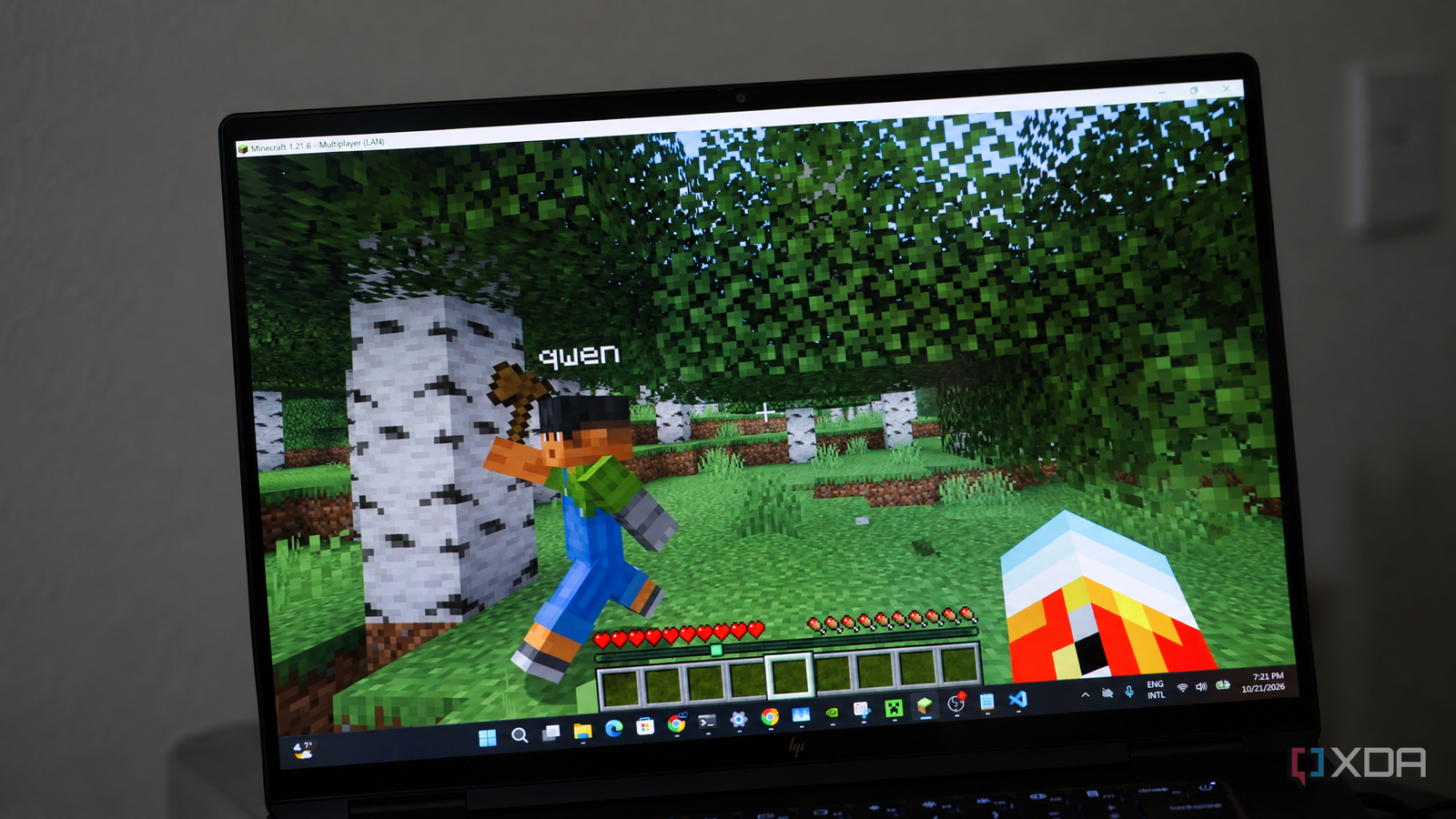
Minecraft has served as a testing ground for next-gen AI hardware: in a test described by XDA-Developers on October 25, 2026, the large language model Qwen 3.8 Flash Next, with 125 billion parameters, controlled a bot in the game while the gameplay itself held a steady 120 FPS on the same machine. It all ran on an HP OmniBook Ultra 16 laptop with an Nvidia RTX Spark chip, which pairs a 20-core ARM CPU with a 6144-core Blackwell GPU and 128 GB of unified memory.
How Mindcraft works
Communication between the AI model and the game world is handled by Mindcraft, an open-source project built on the Mineflayer library, already familiar to Minecraft bot makers. Mindcraft connects the bot to a server just like a regular player, and all information is exchanged through the in-game chat. The LLM doesn't control the character directly: it issues commands as text, for example !collectBlocks("birch_log", 10), and Mindcraft translates them into actual movement, mining and inventory management.
The project also supports a simple form of vision. The !lookAtPlayer command captures an image from the bot's perspective, which lets the model get its bearings without access to the full rendered game view. This approach differs from classic scripted bots built on rigid rules: here, the language model makes decisions in real time about what to gather, where to go and how to react to threats.
RTX Spark test results
According to the XDA-Developers article, Minecraft held around 120 FPS for most of the session, even though a mixture-of-experts model with roughly 6 billion active parameters per token was running in the background. Llama.cpp generated about 46 tokens per second with a short context, and that dropped to just under 42 tokens per second with the context stretched to 32,000 tokens.
- Laptop: HP OmniBook Ultra 16 with Nvidia RTX Spark
- Memory: 128 GB of unified VRAM
- AI model: Qwen 3.8 Flash Next, 125B parameters (mixture-of-experts)
- Game performance: around 120 FPS for most of the session
- Model performance: 46 tok/s with a short context, around 42 tok/s at 32,000 tokens
The author stressed that both applications ran at the same time without any special GPU resource scheduling. The key was memory size: 128 GB of unified VRAM made it possible to run a large model without the size compromises normally forced by the limited memory of graphics cards shared between a game and AI workloads.
Navigation errors, not thinking errors
The test wasn't flawless. The bot made mistakes navigating the world, but the author attributes them to limitations of the Mineflayer library itself, not to the quality of the language model's decisions. The model understood text commands well and planned its next steps correctly, such as gathering specific resources or responding to commands that observe the surroundings.
This distinction matters for anyone interested in building their own Minecraft AI bots: the bottleneck isn't the language model's power, but the intermediate layer that translates its decisions into concrete actions in the game. For players building automation on servers, using mods that expand redstone capabilities or data packs, it's a sign that the limit lies somewhere different than it did a year ago.
What this means for AI experiments in the game
Minecraft has long been a popular testing environment for artificial intelligence, from classic projects like MineRL to newer experiments with agents based on large language models. The RTX Spark test shows that workstation-class hardware with a lot of unified memory can now combine full-fledged gameplay with a large local AI model on a single machine, without sending data to external servers.
For servers and communities building their own worlds with NPC bots or automation, this hints at cheaper access to local AI agents that don't need a constant cloud connection. If you want to experiment with a similar setup yourself, you can check out ready-made world seeds as a starting point for testing exploration bots, and you'll find documentation on recipes and blocks in the site's crafting guide.