
 4 min read
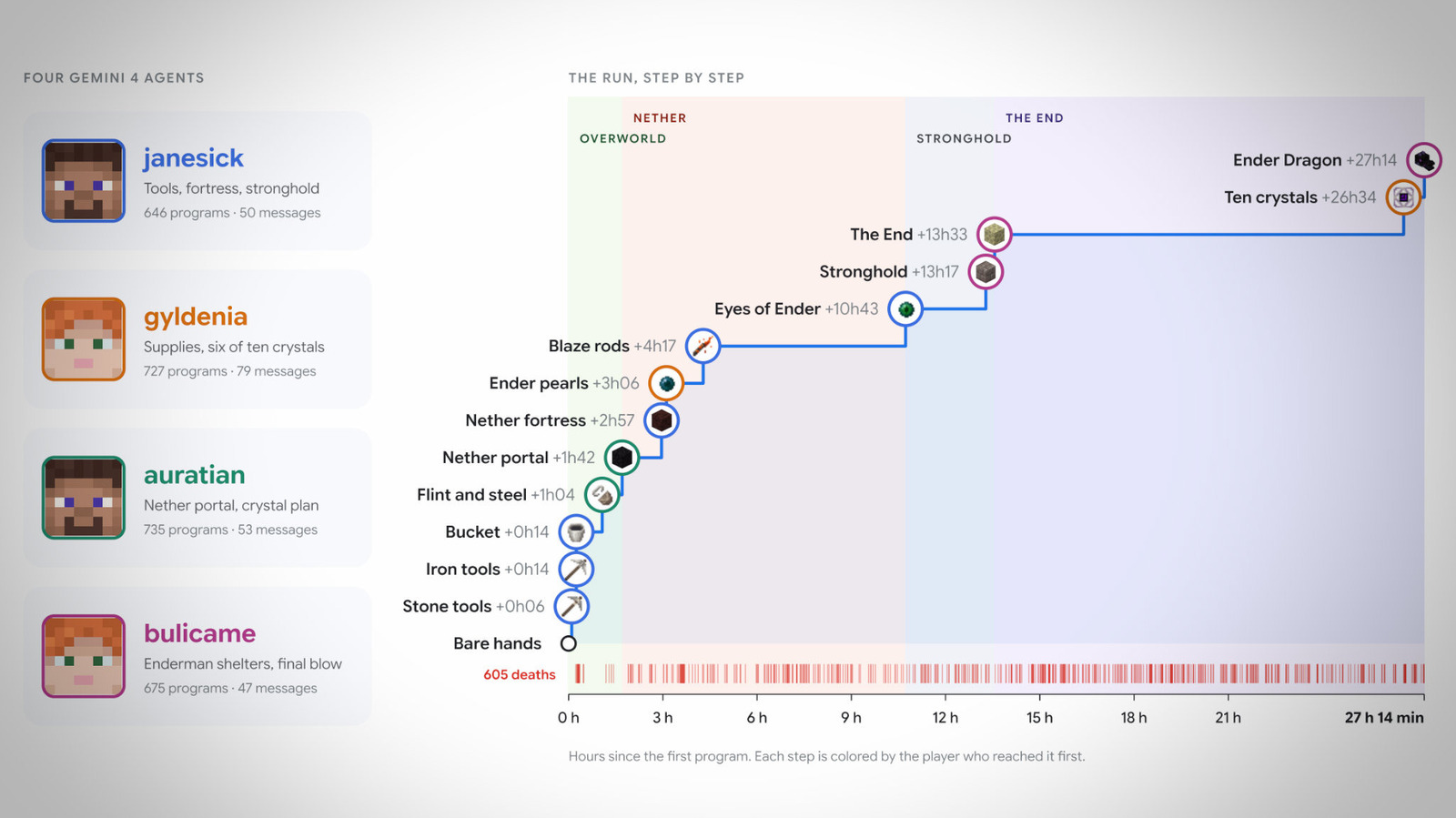
Google DeepMind has published a research paper describing the first fully autonomous Minecraft playthrough by AI agents. Four instances of the Gemini 4 Argon model started from scratch in a randomly generated world on Easy difficulty, and after 27 hours and 14 minutes, defeated the game's final boss, the Ender Dragon, without any human intervention. The researchers wrote in the paper that this was "the first fully autonomous completion of Minecraft by AI agents," achieved using only the standard Mineflayer library, with no pre-searched seeds or dedicated tools written by humans.
How the agents worked
The experiment, published on October 19, 2026, involved placing four agents named janesick, gyldenia, auratian, and bulicame in the same survival world with cheat commands disabled. A fifth agent acted as an observer, making sure none of the four main instances were cheating. The agents communicated solely through text chat and code, sharing tasks, notes, and bug information, exactly as a team of human players planning a joint speedrun would.
Instead of being given a ready-made strategy or specialized tools, the agents had to write all the code needed to control their actions in the game world themselves, using the Mineflayer library. Over the course of the playthrough, they wrote a total of 2,783 programs and exchanged 229 chat messages between each other, coordinating resource mining, gearing up, and exploring the Nether.
605 deaths and a marathon fight with the Ender Dragon
The road to victory wasn't flawless. The agents died a total of 605 times over the course of the entire playthrough, with 69 of those deaths occurring during the final boss fight alone. The confrontation with the Ender Dragon itself lasted nearly 14 hours, which accounts for more than half of the total time it took to complete the game. For comparison, a human player who knows the game can defeat the Ender Dragon within minutes of entering The End, which shows how costly it was for the AI to arrive at an effective combat strategy through trial and error, without prior knowledge of the boss's mechanics.
According to data cited by TheNextWeb, the agents processed roughly 1.35 billion input tokens over the course of the whole experiment. That's an enormous number, which translated into concrete computational costs: the win cost about $520 at the introductory Gemini 4 Argon API pricing, and at standard pricing the cost would rise to about $1,040. The full research session, including additional attempts and monitoring, cost the company between $810 and $1,620.
Why this matters for AI research
Minecraft has long been a testing ground for artificial intelligence precisely because there's no single optimal path to victory. The game demands long-term planning, resource management, building, and decision-making under uncertainty, skills that are far harder to train than those needed for classic board games like chess or go. Earlier research projects, including a recently covered model with 125 billion parameters playing Minecraft at a high frame rate, focused on a single agent performing specific tasks.
The Gemini 4 Argon experiment goes a step further, testing the ability of multiple independent agents to self-organize and divide labor on a task that requires hours of continuous, unsupervised action. DeepMind researchers emphasized that human involvement was limited strictly to safety monitoring, and that all game logic and control code was created autonomously.
What this means for players
For the Minecraft community, this result is a technological curiosity, not a threat to multiplayer gameplay or to servers where players still plan their own strategies against the Ender Dragon. It's worth noting, though, that AI tests in Minecraft, including this latest one, took place in a standard survival environment available to any game owner, without mods or special tools, which highlights the versatility of the game's engine as a research platform. Anyone interested in their own approach to defeating the Ender Dragon can find tips and strategies in the site's guides, and a full overview of game versions is available in the version overview section.