
 4 min read
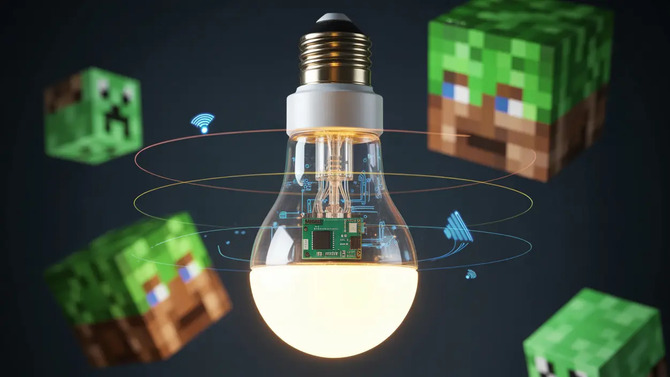
Minecraft just got the humblest host in its history: a smart LED bulb from AliExpress bought for about $2. A creator known as Vimpo got a minimalist, custom-built Minecraft server running on it, written from scratch in C, proving that basic gameplay can run on a microcontroller roughly as powerful as a calculator from the 1990s.
A Light Bulb as a Computer
At the heart of the project is the BL602 chip: a single-core RISC-V processor clocked at 192 MHz, with 128 kilobytes of ROM and just 276 kilobytes of RAM. That's a spec sheet where even the simplest smartphones look like supercomputers by comparison. The chip is normally found in budget smart home gadgets, including light bulbs like this one, since it supports 2.4 GHz Wi-Fi and Bluetooth Low Energy 5.0, both needed to connect to smart home apps.
Vimpo took the bulb apart, desoldered the board with the BL602 module, and hooked it up to a programming adapter to flash his own firmware over USB. The LED, which normally lights up in sync with the smart home app, became a simple status indicator for the server. Once reprogrammed, the module went back into the bulb's housing, which still technically works as a light bulb, just one that also happens to host a Minecraft world now.
UCraft: A Server in 46 Kilobytes
The server software, which Vimpo named UCraft, is a custom implementation of the Minecraft network protocol written in pure C, optimized for devices with drastically limited resources. The server binary without authentication takes up about 46 kilobytes, while the version with player login and authentication support grows to around 90 kilobytes.
In terms of memory usage, the numbers are even more impressive in practice. For a realistic scenario with ten connected players, the server without authentication needs about 20 kilobytes of dynamic memory, while the version with full authentication needs about 70 kilobytes. In theory, according to heise.de, the system could handle up to 1024 clients at once, though Vimpo hasn't tested that scenario on real hardware.
Limited, But Real Gameplay
UCraft doesn't offer the full survival experience known from Minecraft Java Edition or Bedrock Edition. The implementation supports simplified game modes, similar to simple minigames like TNT Run, where movement, collisions, and basic block interaction are the main focus. Logging in, moving around the map, text chat, and placing blocks all work, which for a device with these specs is already quite an achievement.
The project fits into a long tradition of hobbyist attempts to get Minecraft running on absurdly weak hardware. The site ithardware.pl points out that the community has previously built things like an AI-powered chat implementation using 439 million blocks in the game world, and another creator set up a server written in COBOL. Vimpo continues that line of experiments, pushing the boundary of minimalism down to a single, cheaply bought smart home gadget.
Why This Matters to Players
For most people playing Minecraft on PC, console, or phone, a project like this won't replace a normal server for playing with friends. But it does have educational and inspirational value: it shows how the game's network protocol is built under the hood, and how little it takes to recreate its simplest piece. It's also a reminder that the modding and development scene around Minecraft keeps experimenting outside the main, official update channel maintained by Mojang Studios, which supports Minecraft Java Edition and Minecraft Bedrock Edition.
Anyone interested in their own hosting experiments might want to start with something friendlier, like setting up a classic server on a home computer or a Raspberry Pi, before trying to replicate Vimpo's feat on a microcontroller worth a couple of dollars. It's worth remembering that the full functionality of the game, such as generating large worlds, redstone, or the complex mechanics covered on the Minecraft Wiki, requires far more powerful hardware than the BL602.
What's Next for the Project
UCraft remains a hobbyist experiment, not an official product from Mojang Studios or Microsoft. Vimpo hasn't published a detailed installation guide for others who want to replicate the project, which limits its reach to people familiar with RISC-V microcontroller programming and soldering. Regardless of its practical usefulness, the experiment has made headlines in tech outlets worldwide, from Germany's heise.de to America's Tom's Hardware, showing just how much interest there is in combining Minecraft with unusual hardware.
