
 4 min read
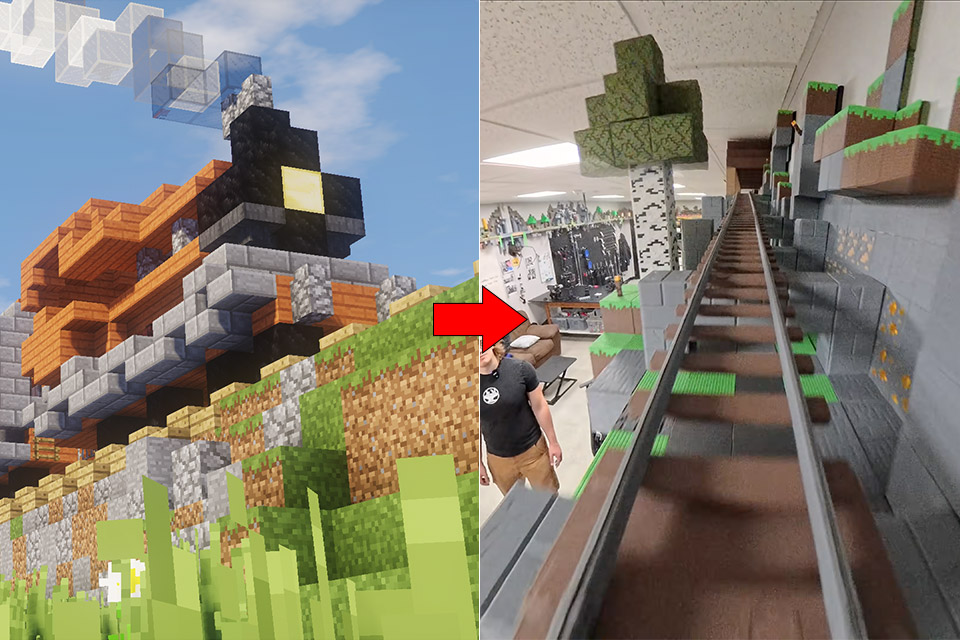
Minecraft has inspired another wild project from the well-known Canadian crew Hacksmith Industries. Creator James Hobson and his team spent eight months building a fully functional rail network modeled on the game's mechanics, with real minecarts running on scaled-down rails laid out across their office. The project, covered on November 3, 2026 by TechEBlog and a day later by Adafruit, turned one of the workshop's rooms into a miniature world full of blocks, caves, and rails powered almost exactly like in the game itself.
From a shared server to the workshop
The idea came from a purely absurd observation: during shared sessions on a fresh Minecraft server, the Hacksmith crew always lays down Rail with minecarts within a day or two, just so they don't have to walk across the map. James Hobson once stumbled across an online description of a home garden rail diorama, and the next morning he brought the idea into the company's office. That habit carried over from the game, combined with inspiration from real-life model railroading, turned into a plan to build a miniature Minecraft world you could actually send a train through.
Eight months of work passed from the first sketch to the finished installation. The team had to combine several different disciplines at once: G-scale model railroading, large-scale 3D printing, and the basic electronics needed to power the rails.
Technique at a scale of 1:23.8
The physical diorama uses G-scale model rail track with an 85-millimeter gauge, and the world's blocks were printed at a scale of 1:23.8, meaning each cube is 42 millimeters per side. To print everything, the team used 222 kilograms of filament, running more than a dozen Bambu Lab H2S and X1 Carbon printers in parallel. The shelving units supporting the diorama alone consist of 124 printed parts, each taking about 13 hours of print time.
For the finest details, like textures resembling the game's blocks, the team used a UV resin printer, which allows for much higher resolution than standard filament printing. This combination of model-making techniques and an industrial-scale printer farm explains why the project took so long, even though the core idea seems simple.
Powered like an enchanted Powered Rail
The most clever part is how the minecart gets powered. Nickel welding strips, normally used for battery packs, were pressed into grooves on top of the rails, letting a constant current flow along the entire route, just like redstone power in the game. The cart itself is driven by a small geared motor, powered through a diode bridge and capacitor, which keeps the ride stable even over rough sections of track.
One of the most unusual stretches of the diorama is a section that climbs straight up a vertical ramp, specifically designed to mimic the Powered Rail mechanic from Minecraft, where minecarts can climb steep sections without any curve in the track. That detail shows the creators cared not just about looks, but also about faithfully recreating the physics rules known from the game.
An amethyst cave in the middle of the office
The rail route doesn't stop in one room. The rails exit the video editing room through holes cut above the door frames, pass several structural steel beams, and come back through more small breaches in the walls. Along the way, the minecart also passes through a cave filled with amethyst crystals and carved stone, recreating the cave biomes known from the game.
This kind of layout, with the route running through different rooms and levels of the office, makes the project something more than just a desktop diorama. It's essentially a miniature railway operating within the real space of the company, designed as if someone were actually exploring an underground minecart system from the world of Minecraft.
What this means for builders
Hacksmith Industries has spent years bringing mechanics from games and pop culture into the world of real engineering, and this time they picked a transport mechanic familiar to anyone who's spent any real time in survival mode. For players designing their own rail networks in their worlds, the project is a reminder that inspiration can flow both ways, from the game into the workshop and back again. Anyone looking to build their own, more elaborate in-game transport systems can find ideas in our building guides, and fans of rail and redstone automation can check out ready-made projects in our tools and calculators section. If this story inspires someone to build a similar setup in-game, it's also worth checking out our list of mods that expand the rail and minecart system.
