
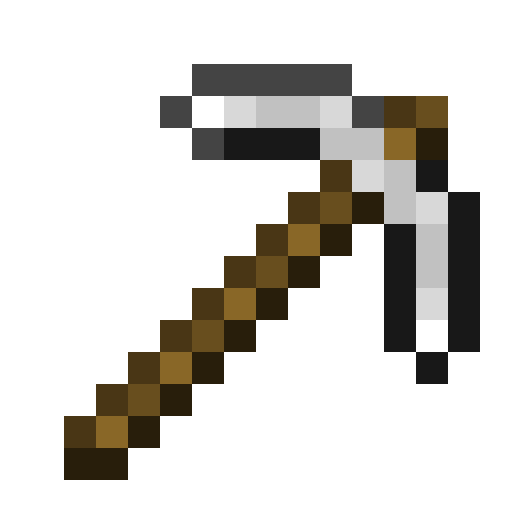
Mining resources
Where to mine coal, iron, diamonds and netherite: a complete guide to mining.
Mining is the main source of resources in Minecraft and one of the most important parts of playing in Survival mode. Ores generate at different depths (Y levels), and where they appear changed significantly in the 1.18 Caves & Cliffs Part II update. Knowing where to look for each resource saves you a lot of time and lets you progress through the game faster. This chapter is a complete guide to every ore and the techniques for mining it.
How do you check your depth? Press F3 to open the debug screen. Look for the "XYZ" value: the second number (Y) is your height relative to sea level. Sea level is at Y=63, and the bottom of the world goes all the way down to Y=-64. The deeper you dig, the more valuable the resources you find, but the bigger the danger from lava and hostile mobs.
Coal
The most common ore in the game and the first one you'll come across while exploring. It generates at every height from Y=0 to Y=320, with the highest concentration at Y=96. Coal is extremely useful: it's fuel for a furnace (8 smelting operations per piece) and an ingredient for torches. Early in the game, collect it whenever you can, because you'll need a huge number of torches. You can also use it to trade with villagers: the fisherman and the armorer.
Copper
An ore added in version 1.17 that generates from Y=-16 to Y=112, with the best level at Y=48. Copper is mainly a decorative material: you make copper blocks from it, which oxidize over time and change color from orange to turquoise (which gives interesting building effects). It's also used to craft spyglasses (with amethyst shards) and lightning rods. In Dripstone Caves biomes, copper generates in larger amounts.
Iron
One of the most important resources in the whole game. It generates in two main zones: from Y=-24 to Y=54 (peaking at Y=16) and from Y=80 to Y=320 in mountain biomes. The best strategy is to mine at Y=16 or explore large caves. You need iron for tools, armor, buckets, shields, compasses and many other key items. An iron pickaxe lets you mine diamonds and other valuable ores, which is why getting iron is your top priority in the early game. In the long run, it's worth building an automatic iron farm with iron golems.
Gold
It generates from Y=-64 to Y=32, with the highest concentration at Y=-16. In the Badlands (Mesa) biome it also generates at higher levels, which makes this biome an excellent source of gold. Gold has a surprisingly wide range of uses: golden apples (key for boss fights), clocks, powered rails for railways, and above all bartering with piglins in the Nether. By throwing them gold ingots, you can get valuable items, including ender pearls and obsidian.
Lapis Lazuli
It generates from Y=-64 to Y=64, with the best level at Y=0. Lapis is essential for enchanting items: every enchantment at an enchanting table costs 1 to 3 lapis lazuli. Keep a few stacks in reserve, because enchanting is a key part of progressing in the mid and late game. You can also use lapis as a blue dye for dyeing wool, leather and other blocks.
Diamond
The most valuable and sought-after resource in Minecraft. It generates from Y=-64 to Y=16, with the best chance of finding it at Y=-59. Since version 1.18, diamonds don't generate exposed to air, so you'll find far fewer of them in open caves than in solid rock. The best way to mine them is strip mining at Y=-59: digging long tunnels in a straight line. Use an iron or diamond pickaxe, because anything weaker won't mine diamond ore.
Warning: Since version 1.18, diamonds generate more rarely than in earlier versions of the game. Plan your mining carefully and don't waste diamonds on a shovel or a hoe: iron is good enough for those.
Redstone
It generates from Y=-64 to Y=16, with the most at Y=-59 (the same level as diamonds, so while mining for diamonds you'll run into lots of redstone). Redstone is Minecraft's "electricity": you use it to build mechanical circuits, automatic doors, traps, automatic farms and complex machines. You'll find a full guide to redstone circuits on our site. You also need redstone to craft a compass, a clock and a redstone torch.
Emerald
It generates only in mountain biomes, from Y=-16 to Y=320, with the best level around Y=256. Emeralds appear one at a time: you'll never find a vein of several blocks next to each other. That's why it's much easier to get emeralds by trading with villagers than by mining. Emeralds work as a trading currency: with them you can buy diamond tools, enchanted books and many other valuable items from villagers with the right profession.
Mining techniques
There are several proven mining methods, each with its own advantages:
- Strip mining: digging long tunnels at a set depth (ideally Y=-59 for diamonds). A simple and effective method. You dig a tunnel 1 block wide and 2 blocks high, and every 3 blocks you branch off to the side with short side tunnels. This is the safest technique.
- Branch mining: a variant of strip mining with branches that form a tree pattern. You dig a main tunnel, and every 4-6 blocks you make branches on both sides. It maximizes how much ground you cover.
- Caving: exploring natural caves and underground systems. You find large amounts of ore exposed on the walls faster, but it's much more dangerous: hostile mobs, lava lakes and the risk of getting lost. Bring plenty of torches and a Potion of Fire Resistance.
- Staircase mining: digging a staircase down at a 45-degree angle. A safe way to get down to deeper levels without the risk of falling into lava. Ideal for reaching Y=-59.
The golden rule: never dig straight down! You could fall into a cave full of hostile mobs, straight into a pool of lava or into a bottomless drop. Always dig in a staircase or a spiral. This rule has saved the lives of millions of players and should be burned into the memory of every miner.
Mining is a fundamental skill in Minecraft that ties into every other part of the game. The resources you mine let you craft better tools, make stronger armor and prepare for trips to the Nether and the End. In the next chapter you'll learn how to cook food efficiently and manage your hunger bar.
