

 4 min read
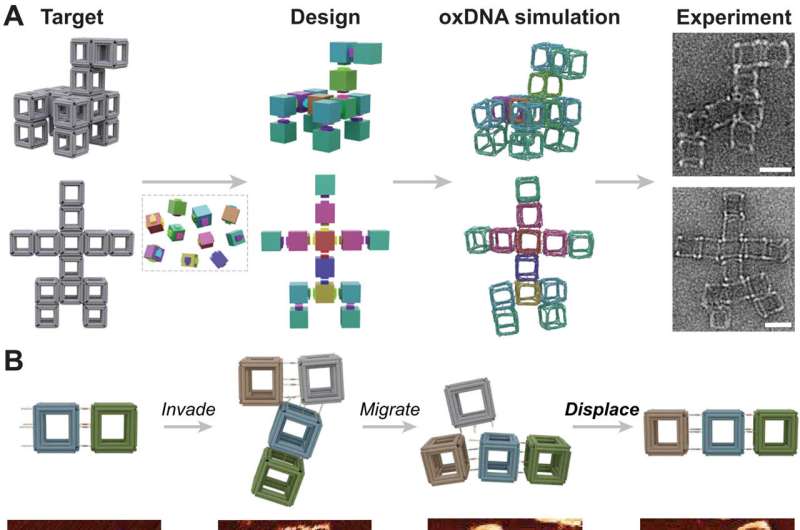
Scientists at Arizona State University have built a lab structure made of roughly 400 microscopic DNA cubes that self-assembles into an object over 500 nanometers in size with a mass of about 2 gigadaltons. The study, published on November 25, 2026 in the journal Science Robotics, describes a method that its lead author, Professor Petr Sulc of ASU's School of Molecular Sciences and the Biodesign Center for Molecular Design and Biomimetics, compared directly to Minecraft: "It's like playing Minecraft on a very, very small scale."
Building blocks that connect themselves
Each DNA cube designed by Sulc's team has programmed connectors on its surfaces that determine which other cubes a given piece can bond with. The mechanism resembles how crafting works in Minecraft, except nobody manually clicks a grid: the molecules find their own place once mixed together in solution.
Instead of manually placing every single piece, researchers program the bonding rules themselves, and the structure forms spontaneously. This answers one of nanotechnology's long-standing problems: how to reliably build complex objects at the nanometer scale without positioning every component individually. The project was carried out mainly by a team of Sulc's PhD students, and the first nine authors of the paper are students, including PhD candidates Thong Diep and Hao Liu, who did most of the computational and experimental work.
A size record: 400 cubes and a Menger sponge
The team experimentally assembled a structure of around 400 DNA cubes measuring over 500 nanometers, said to be the largest non-crystalline 3D structure ever built from DNA. Beyond that, the researchers also created a 129-piece octahedron and a complex fractal known as a Menger sponge, which required 19 different cube types as building blocks.
Behind this precision are intensive computer simulations, some involving over 3.5 million particles, which helped minimize the number of cube types needed while avoiding unwanted connections. As Sulc summed it up in the university's press release: "These are very complex objects, and it would be impossible to design them by trial and error."
Cubes that swap themselves out mid-build
One of the system's more unusual features is a so-called cube exchange reaction: new DNA pieces added to the solution can replace ones already built into a finished structure. This means an object can be rebuilt without starting from scratch, something the team demonstrated with a "dancing robot," where adding new cubes shifted parts of the structure already in place.
This mechanism opens the door to reprogrammable nanostructures that change shape on demand instead of just assembling once and staying fixed. It's more than a static model: it's a system that can be modified much like a world in Minecraft can be rebuilt at any moment, except here it happens on a scale millions of times smaller than the human eye can see.
From nanoelectronics to an open project database
In collaboration with Emory University, led by Professor Yonggang Ke, the team attached carbon nanotubes to the DNA cubes, taking advantage of DNA's natural affinity for nanotubes along with complementary sequences to place them within larger structures. It's a step toward 3D electronic circuits built at the molecular level.
Sulc has also launched NANOBASE.org, an open repository where other researchers can share their own DNA structure designs and download ready-made building blocks developed by the ASU team. The research was funded by the US Department of Energy's Basic Energy Sciences: Biomolecular Materials program, grant DE-SC0025265.
Minecraft as the language science uses to describe the nanoworld
This is another example of researchers using Minecraft as the simplest way to explain a complicated process to a wider audience, instead of describing it purely in biochemistry or molecular physics jargon. A game where the player places blocks one by one turns out to be a convenient metaphor for a process in which molecules find their own place without any hand holding a controller.
For now, the project has no announced commercial applications, and the team's next steps are developing NANOBASE.org further and continuing experiments with reconfigurable nanorobots and 3D circuits based on carbon nanotubes. For more stories like this from the world of technology and Minecraft, check out the news section of our site.