






 4 min read
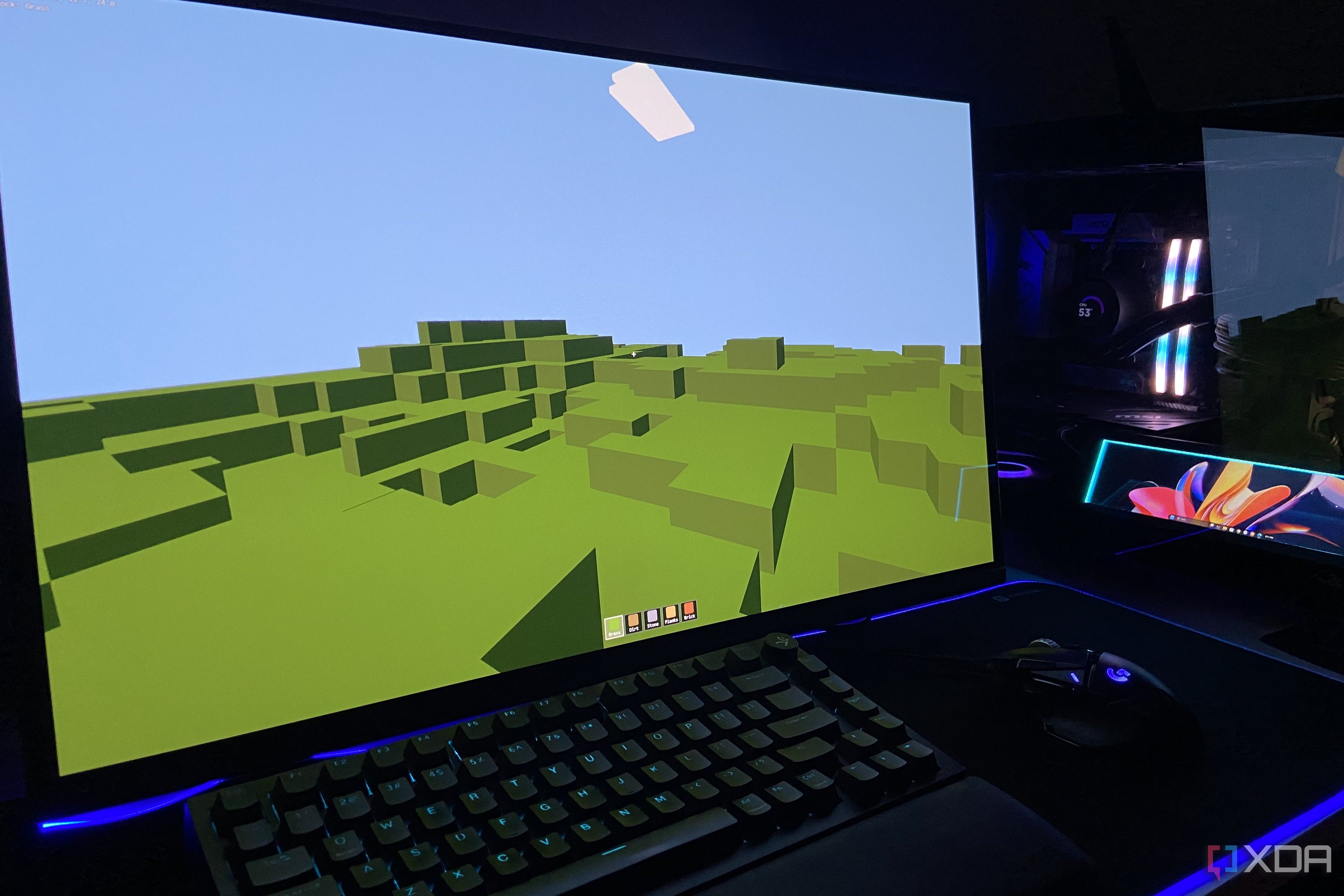
Minecraft has served AI developers as a testing ground for years, since the game's simple nature makes it easy to see whether a model understands physics, space, and 3D world logic. The latest test, conducted by an editor at XDA Developers, went a step further: three local language models were tasked with writing a single-file HTML app using the Three.js library from scratch, recreating basic Minecraft-style gameplay. Only one model passed all five tested functions.
How the test worked
The author of the test ran all three models on a single RTX 4070 Ti Super (16 GB VRAM) graphics card, a Ryzen 5 7600X processor, and 32 GB of DDR5 RAM, using the llama.cpp runtime with a 128,000-token context window. The models ran at UD-Q4_K_M quantization from Unsloth, which allows large weights to fit into the GPU's limited memory without a cloud server.
Three fresh open models were selected for comparison: Qwen3.6-35B-A3B from Alibaba, Gemma 4 26B-A4B from Google, and Nemotron 3.5 Lightning 30B-A3B from Nvidia. Each received an identical prompt: write a standalone HTML file with a Minecraft clone where the player can walk using WASD, jump with spacebar, break blocks with the left mouse button, place them with the right mouse button, and change the block type using number keys.
Results of each model
Gemma 4 won the test, being the only one to pass all five checked functions: walking, looking around, jumping, breaking blocks, and placing them without clipping through the ground. The model generated 4,762 tokens in 1 minute 25 seconds, at an average speed of 55.43 tokens per second. The generated world measured 32x32 blocks, smaller than the competition's, but fully functional.
- Gemma 4 26B-A4B: 5 out of 5 tests passed, 4,762 tokens, 1 min 25 s, 55.43 tok/s, a working 32x32 world
- Qwen3.6-35B-A3B: 2 out of 5 tests, 8,495 tokens, 2 min 19 s, 60.74 tok/s, an ambitious 48x48 world, but physics bugs launched the player into the air
- Nemotron 3.5 Lightning 30B-A3B: 0 out of 5 tests, 5,677 tokens, about 2 minutes, 47.74 tok/s, a black screen and loading errors
Qwen3.6 was the fastest and generated the most code, attempting to build the largest world of the three models. The problem was that the player spawned in mid-air, and a leftover collision routine in the code turned falling into an upward-pushing force, making the game unplayable. Nemotron suffered the clearest failure: the generated world ended up as a single black block, with errors appearing when loading the page.
Why Minecraft is a convenient AI benchmark
The game's simple rules, cubic blocks, and limited set of mechanics make a Minecraft clone a popular task for evaluating how language models handle code that combines graphics, physics, and keyboard/mouse input handling in a single script. This task is considerably harder than typical text-based benchmarks, since a bug in a single line of block collision code shows up immediately on screen, without needing to dig through logs.
The test using local models carries extra significance for anyone interested in Minecraft mod and tool development: it shows that open source models with 26 to 35 billion parameters can run on a single RTX 4070 Ti Super class card and still produce sensible, working code without sending requests to an external API. For players building their own mods or experimenting with AI-generated structures, this is a concrete reference point for which local models actually understand spatial logic similar to the game's.
What this says about the direction of open source models
The test's result contrasts with earlier reports of AI agents operating directly inside Minecraft, where bots had to deal with an already-existing game world instead of writing one from scratch. Here the task was reversed: the models weren't playing Minecraft, they had to program it, which tests a completely different skill, understanding the game's code rather than making decisions within its world.
The spread of results among three similarly sized models, ranging from 0 to 5 passed tests, shows that parameter count alone doesn't determine code quality in tasks combining 3D graphics with physics. Gemma 4, despite generating the smallest world, proved the most predictable and consistent in implementing basic collision rules, which in practice mattered more than map size or code generation speed.